pMad — the “Chance” single and “Trust Devoured” ep

We belive the pMad is a young, new group with a significant amount of potential. However, as they sound now, to us they have an inescapable fatal flaw. If you’ve read my reviews you know there’s one thing I hate above all else; auto-tuned vocals. It’s what separates the production I hate from the 21st century from the music I love, most of which is from the 20th century. There’s an easy way to remedy this, however. And that’s to use vocals that are only affected with twentieth century effects and/or pedals.

Otherwise, you’re going to get that garbage Kanye West (and every other pop singer from the last 25 years) pitch corrected sound. Which means you sound like a robot. In a way it levels the playing field because anyone can SOUND like they can sing and are on key using this and other digital effects. But to me, in a more important way, it homogenizes everyone. And as if the use of AI to create whole songs and albums on platforms like Spotify where they often go unnoticed wasn’t bad enough, vocalists like pMad’s make themselves sound like robots thereby pre-eliminating their individuality and humanity.

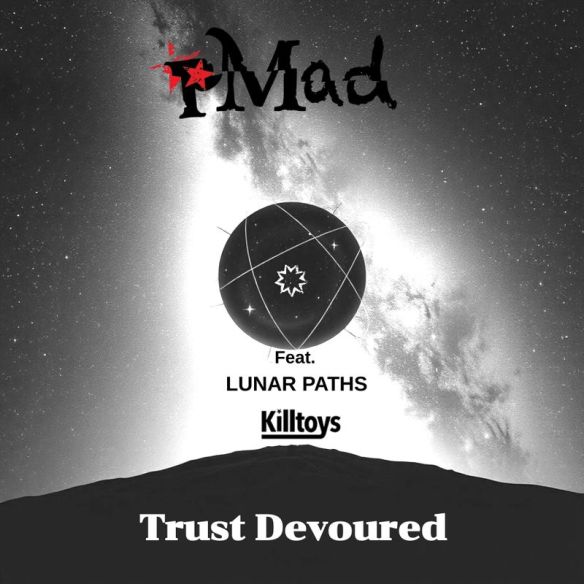
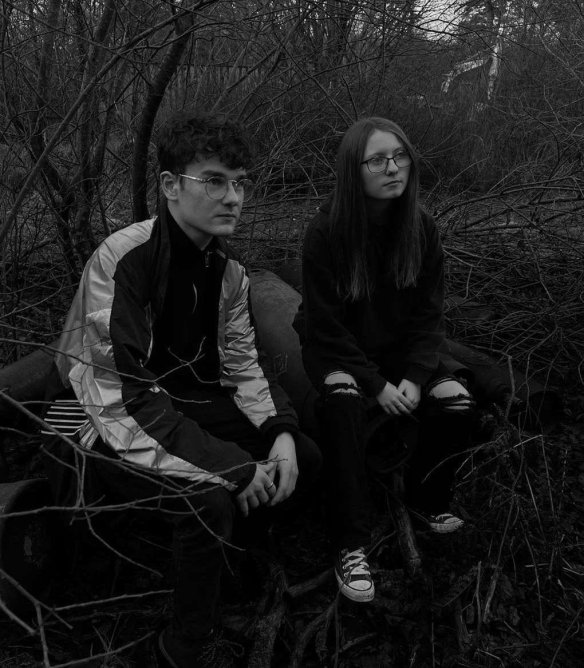
Other than that, pMad is what it advertises to a degree. The sounds are informed by the post-punk/early Goth genres of the late seventies and early eighties. Another respect in which pMad differs, however, in another way I don’t like, reminds me of the scene in 24 hour party people where the narrator indicates “something equally epoch making is happening…They’re applauding the DJ. Not the music, not the musician, not the creator, but the medium.” pMad fits better into this epoch of New Order than that of Joy Division. Their songs are remixed. They utilize the designs of other artists for rhythm tracks –which makes it confusing as to who I’m actually listening to and reviewing — the “Trust Devoured” ep features two other artists, in what pMad calls “a boundary-pushing collaboration alongside UK/USA’s Lunar Paths and Australia’s Killtoys — a unique musical venture that brings together 3 artists from across the world to create something greater than the sum of its parts.”

We know there’s supposed to be a degree of talking up the music on the record in press kits and oftentimes a label or marketing agency writes it as opposed to the artist themself. However, in all the materials sent to us they mention this “Exquisite Corpses” (which if they were to do it correctly i.e. by the ‘Exquisite Corpse’ member of the Zurich dada collective very early in the twentieth century they’d have one word from one artist followed by another word that’s blind to the first word from the second and so on, or at least alternating lyrical lines) project several times as if it’s the Bees Tits. And it all comes off as, well, pretentious. As do the lyrics in general which are not, disappointingly, abstract, conceptual, or Dadaist in any way shape or readymade. They’re more like a teenager’s journal of despair. It’s possible they’re very young, it’s likely that their band is very new anyway.

Hopefully they won’t take criticisms like these to the detriment of their ‘souls’ (we’ve always wondered what it’s like to have one of those) but will rather use them as an opportunity to see where they could improve AND where they draw the line and say “Times Boredom’s critics SUCK and they’re all wrong about the vocals!” (it’d be nice if they’d get mad instead of just continuously sing speaking the same downbeat melody over and over — it’s almost as if they need all the digital effects they’re using to make the vocals stand out and be entertaining…)

We honestly didn’t want this review to be dumping on them as much as we clearly have (sorry), because the music’s really not bad. It’s actually pretty enjoyable in the drone heavy style of unemotional depressing tunes. The best parts of pMad are those that remind us of Joy Division and early The Cure. It’s quite possible that if the vocals made less use of digital effects (you can hear a little less on ‘Closer’ — it sounds like it might be a direct reference but it is indeed meant to be CLOS – ER, not CLOSER as the 2nd and final Joy Division album cleverly is), the single and the ep would be far more enjoyable. It’s not necessarily or undeniably bad to use digital effects and make yourself sound ‘closer’ and ‘closer’ to a robot, it’s just something that I personally don’t like. It can ruin what would otherwise be a pretty good tribute to early post-punk and goth… and for me, it has.

Not to mention the marketing on their website rubs we noncommercial not for profit democratic socialists all wrong. Having merch is one thing. Having beautiful people models display the wearable merch? And all the emphasis on the logo and branding — just no. Not for us. No.

Hence if it sounds like dumping. I apologize; but I really can’t stand vocals that are affected in this machine like way to the degree that they are. I can’t get past it. I hear the tunes underneath and somewhat enjoy them, but the overaffected vocals are a near constant presence on both the “Chance” single (another collaboration with a different artist Think- Marco Menazzi — again, how much of this is pMad and how much the other people?) and the “Trust Devoured” ep.

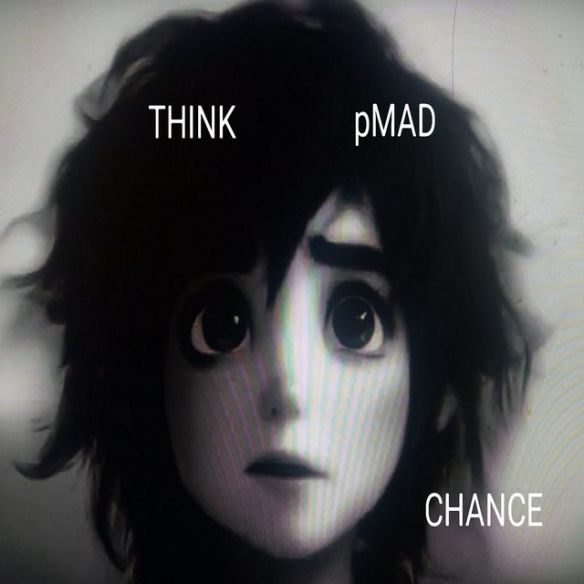
Perhaps it’d be useful to constructively delve further into the Chance single. The tune and the energy are great, jaunty even where the ep is far more droney and dark. However, due to pMad’s insistence on collaborating with one or multiple artists on all of their tracks, we don’t know how much of this is pMad and how much is Think — it stands out as a very different track then the ep which leads us to believe the other artists are writing more of the basic songs then one would think since the pMad name is clearly stamped (and sent) first.

-A ‘collaboration’ between Scott Koenig and artists/procurators xxStevexx, Keith, Kasreal, and Jessica

Vacant Pavements’ The Cost of Complaceny

Another submittal, another bizarre European entry from a highly produced but unimpressive group going nowhere.

They caught our attention because of their mention of gothic/post-punk influences we love; that familiar Bauhaus, Joy Division, The Cure goth grandfathers trio. Granted we haven’t really moved on since then, nor have many of our Gen X friends and colleagues that are happy to continue looking for ‘deleted Smiths singles’, as they play the first 3 Cure, 3 Joy Division, and the five or so studio records by Bauhaus ad infinitum (and of course as purists they’ve got the first few New Order, Love and Rockets, and all the later Cure records but they don’t really get much spin), however, we’d think a group from Glasgow Scotland would have. There should be a whole laundry list of obscure British goth groups since then, even those that may directly ape the 3 grannies, that they know about but we don’t. Or maybe this is just their way of trying to relate to what they think we might actually know.

In any case it doesn’t work. They don’t even sound like a poor man’s version of any of these greats. Their music is twenty first century production and perhaps seventies post punk vocals. They’re probably trying very hard to write seventies post punk melodies for their vocals, but again, not working. Some of the tunes border on the interesting, like the instrumental ‘The Core’, but it’s more of an electronic noise curiosity than what they’re trying (or say they’re trying) to do.

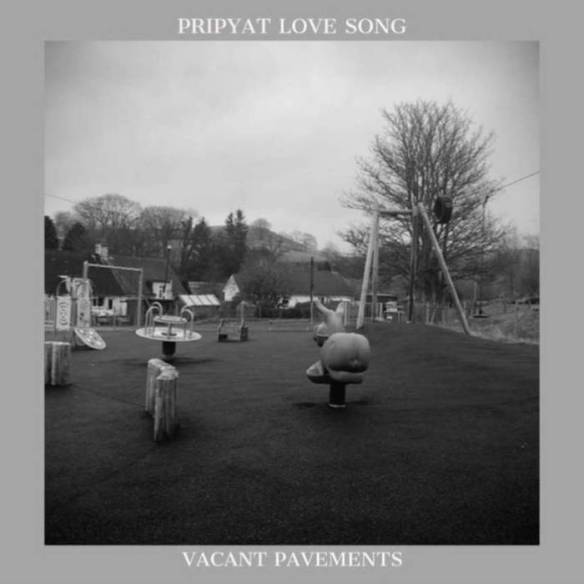
What is interesting, at least in theory, is the fact that all the songs on this their debut ep are about Chernobyl. However interesting the subject might be though, this isn’t anywhere near as good as the mini-series that came out a couple months ago. There’s no real insight or genuine emotion from the lyrics (that are clearly about Chernobyl themes)… witness for example ‘Caesium 137’. No we don’t know what that is and honestly we’re not going to look it up because we’re sure we’ve heard about it at some other point and it’s a contaminating isotope that resulted from the Chernobyl meltdown fallout (sorry, we know no ones really sure if it was a meltdown, an explosion, or… who knows — write about that, the mystery, the uncertainty, the fact that some of the people that worked there were denying anything at all happened up to the point — whatever. We’re not doing your homework for you. Just saying that while the subject matter is interesting, what you’ve written about it is not. You can’t just take some really dark subject matter, sing about it with downtrodden goth vocals and expect it to be anything).

And then there’s the clearly trying to be their ‘Love will Tear us Apart’ “Pripyat Love Song”… this ain’t that. Even if they’d done it first, this wouldn’t have claimed any place in that zone whatsoever. It is, instead, a poor imitation of a classic that sounds more like a song that was written by The National (I can sing along ‘nowhere I thought I’d be by now my head is a buzzing 3 star hotel’ easier than any actual post punk song) and backed up by a slowed down Depeche Mode track… btw it’s ok to admit you like Depeche Mode at this point. Point of fact we’d respect you far more if… ah not worth the ‘ink’.

It’s entirely possible that someday this will be their embarrassing debut wherein they tried to ape their heroes on their way to honing their own sound. Even in that case, however, if the lack of songwriting talent evident on this ep continues, their original sounds will still be marred by, well, suckage. Sorry kids this ain’t doing anything for me.

-xxStevexx

Maple Stave’s unholy blend of post-hardcore and prog on latest album ‘Arguments’

Maple Stave is a hardworking post-hardcore band that’s been grinding out good ep’s and albums since back in aught 3. From Durham North Carolina (not too far from the famous indie rock bastion of Chapel Hill), their special flavor involves 2 baritones and recently an added fuzzy bass guitar for your extra low end pleasure. After 5 releases that exhibited some growth and change but pretty much stuck to the same sound genre playbook, they recently released their standout album ‘Arguments’. And while the title may fool you into thinking this is another band paying tribute to Fugazi’s final similarly titled album (or maybe it is; esoteric references to other rock bands abound on the album), this album represents a pivotal change in their sound, specifically the higher powered vocals and melodies.

Though the underlying instrumentation is akin to and developed from their many years grinding in the post-math rock game, the often harmonized high in the mix vocal melodies are for the first time evocative of the unholy cross breed of hardcore with prog rock. And while it has been done before (most famously by At the Drive In, the Mars Volta and their acolytes), Maple Stave’s version is no one dimensional imitation nor does it sound derivative in any way. This may be the result of their highly skilled use of midwestern math rock style baritone and basslines that are, to ears like mine, the sweet sweet sound of the drudgery of home. Or the fact that instead of putting the ethereal more commercially pleasing prog melodies on all of the songs, they instead utilize the anti-commercial self indulgence of purely instrumental pure post jam jamming on tracks like “Good Luck in Green Bay”, “Cool Attitude’ and the (Helmet tribute?) “Downtown Julie Brown”.

However, much as I enjoy the unbearably catchy chorus to the album’s standout track “The French Song”, if you listen close you can hear a bit of Journey’s Separate Ways (not that that’s such a bad thing mind you — lousiest air synth playing music video though it may have been, the song is pure delectable Motown and not quite prog). That being said, the emotional depth and weight of tunes like The French Song, featuring a maximalist, unusually off kilter (even for the math rock genre) drum line under minimal sustained fuzzy bass and baritone notes coupled with the subtly almost dully whispered single vocals of part 1 followed by a full on assault of grinding of bass and baritone lines, driving noise rock percussion rhythm with the booming, harmonized up in the mix vocal melody truly brooks no genuine similarity to anything as hollow as pop prog in any way. However, most people do put the majority of weight on the vocal melodies of songs and will hear and remember them far more than the rest of the music. And tracks like Cincinatti Hairpiece and Thunderkiss ’85 are quite weightily indebted to At-the Drive Ins melodic guitar lines and screamed emo-prog lyrics that evoke extremity of feelings far more than make sense… The emo goes even further on “Keep Charging the Enemy” and “I’m not Tied to Pretty” with instrumentation and melodies that are damned near pretty. But if any of that sounded negative to you, the sheer overall quality of these tunes and especially that sweet spot between harsh buzz and evocative pith (most evident on album opener “Indian Ocean, Present Day”) makes this a record worth overlooking all things borrowed and just enjoying the quality and growth of a truly sincere group with truckloads of integrity.

I must admit I believe the majority of the lyrics are either abstractly emotionally evocative or go over my head with the exception of ‘Thunderkiss ’85’. The fact that this is exactly 20 years after the “demon warp came alive” makes me think that perhaps every line I don’t understand is also an arcane reference, just one that I don’t get. This song seems to paint a tale of an America (world) that fucked everything up around 1985, when it started unashamedly redistributing wealth from the poor to the rich. Obviously it’s more complicated then that, but it’s one of the few songs with big meaning I thought was discernible — and honestly if I’m right who would argue with that thesis? To the x-ers and millenials it certainly seems “this is how things began to end” in ’85 with income inequality and unchecked corporate power, not the sexual and social changes of ’65 as previous generations thought.

Despite all my bullshit hipsterish criticisms above (that for some reason always make people think I dislike things more than I do), I mean to say I really like this record. And the one before it. And the band. I have a great deal of respect for true hardworking musicians that stick to their guns and write and play and tour non-stop for either the joy of it or just because they feel compelled by the Spirit (of rock). And if they play my town I’ll definitely be the first one there. Let’s hope this is just the most current in a long line of great records far into the future!

Watch excellent cutup frotage video for single “The French Song” at https://maplestave.bandcamp.com/track/the-french-song

Old Town Crier knows that to be political is to be human

It is hard to write a genuine modern political song that isn’t misunderstood or written off as juvenile.

There are specific styles of music whose history is fundamentally tied to pure political expression (punk and folk) – hearing anything that isn’t political in those genres runs the same risk of being misunderstood or not taken seriously. I think this is a reason why the Ramones were so important (getting way off-track).

There is something very honest about Old Town Crier’s latest release (July 1), You, and the way he approaches the political subject matter of his lyrics. He reminds us that to be political is to be human and vice versa. 

There’s an interesting juxtaposition between the music and the lyrics that not only creates an unexpected message but an accessible one.

The opening title track, ‘You’, takes us down a nostalgic route through the annals of British music as influenced by American 60’s Motown music. The connotation of this style harkens back to days of lazy, rainy Sunday afternoons, writing love letters and daydreaming, listening to the Turtles or The Kinks, all the while feeling like the future is wide open. 

Editors note: The cover of the latest album that for some reason is in the style of an old school British punk band, perhaps to fool the non-believers

But the lyrics don’t speak of those idyllic landscapes of post-war Britain, where the dream of America remains untarnished. Quite the opposite is true. By listening to the album “You,” we are dealt with a conflicting message of warm emotion vs. cold politics, progressivism vs. musical modernism – optimism vs. pessimism. 

The dream of America is very much tarnished. Lough’s tone of voice is not angry, condescending or paranoid, however, it is compassionate. This compassion is felt in the music, which is what makes his political stance more “accessible.” 

Old Town Crier is also about taking direct political action: all proceeds of the album ($2,700) went to three Progressives who ran in the US midterm elections – Christine Olivo (FL-26), Angelica Duenas (CA-29), and Derek Marshall (CA-23).

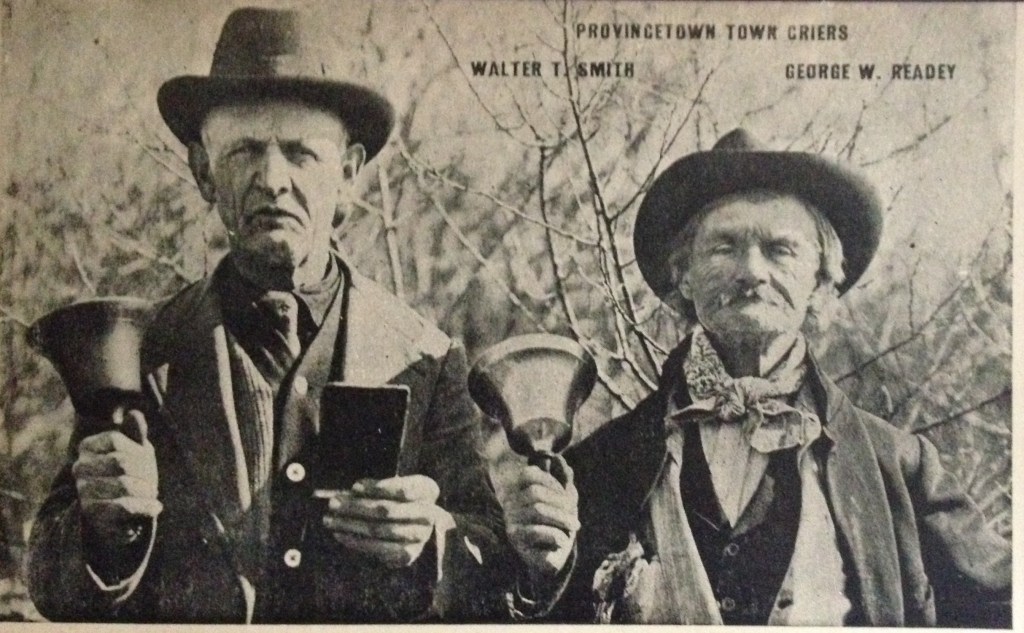
Editor’s 2nd note: believe it or not this is not actually a picture of the band Old Town Crier. It’s what comes up when you google “Old Town Crier You Massachusetts”. Goddamn but people were miserable before the invention of colored photographs. Anyway as editor I’m not allowed/supposed to put in any of my own content, and if Scott finds out he will definitely fire me, but I’ve gotta entertain myself somehow right? Editing is not the most fun work you can do without getting paid for it. Take this Scott!

The second track, “Thin Blue Line,” with all of its new-wave synth flare of Springsteen-meets-Costello is bold in its imagery, but Lough doesn’t seek to insult the listener’s intelligence by casting blame on one side or another. 

Instead, he paints a very realistic picture that the “thin blue line” separates us from one another, causing more fear through division. “There’s a thin blue line, between hate and fear/the thin blue line’s never been so clear.” 

Track three, “Coal River Mountain,” takes us back to Old Town Crier’s first release, with their origins of bluegrass coming back but to a backdrop of their vintage dirty guitar-blues rock outfit.

Editor’s last note since I’m definitely getting fired after this: I’m pretty sure this is a picture of the Old Town Crier band but it’s not official or anything so don’t quote me.

“Radio On” is the weakest song on the album, but probably still contains enough anthemic energy to at least get the crowd to sway back and forth a few times.

In my review of Old Town Crier’s first release, I’m Longing for you Honey in Middleboro, Mass, I had speculated that Old Town Crier was merely a “side project” for singer-songwriter Jim Lough. With his latest release, Lough’s songwriting has evolved and has revealed that he is a musician with a vision. 

You was mixed and mastered by Dave Westner, while Howie Klein was the executive producer. You can find Old Town Crier’s latest release here: https://oldtowncrier.bandcamp.com/album/you

-Drew Wardle

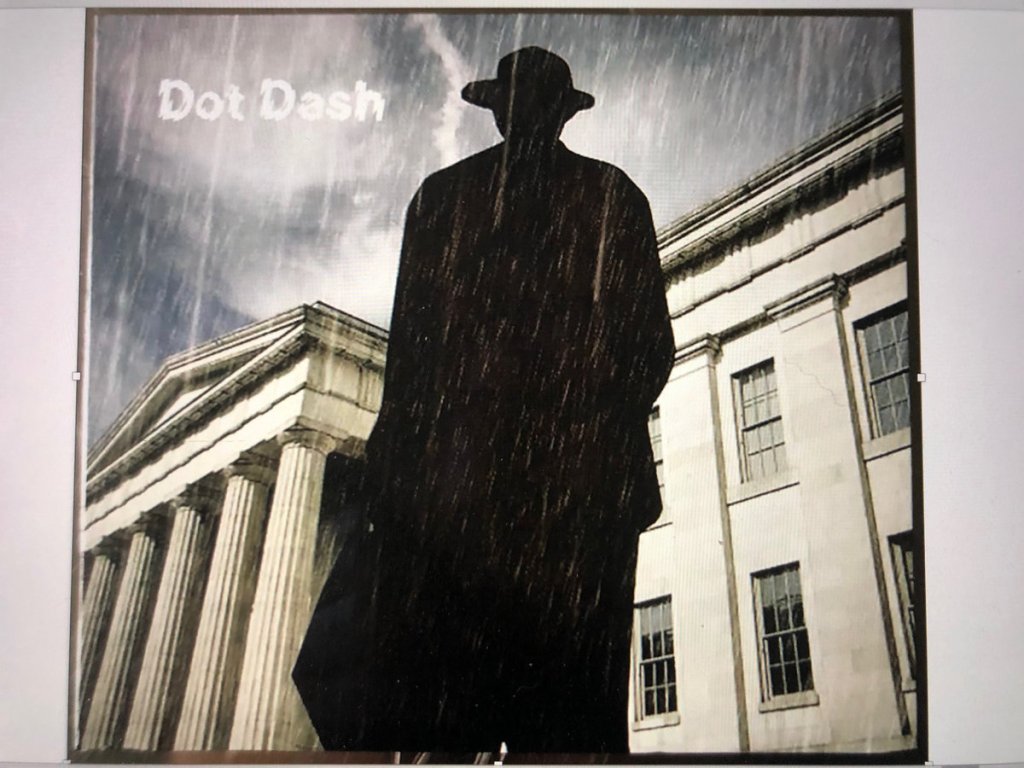
Dot Dash – “Madman in the Rain” 

The grandiose (and somewhat tacky) album title, “Madman in the Rain,” has created a mild but persistent saccharine taste in my mouth. 

It is a kind of middle-of-the-road sensation that cannot move past its own identity crisis – because the music on said album lacks any conviction and does not take risks. 

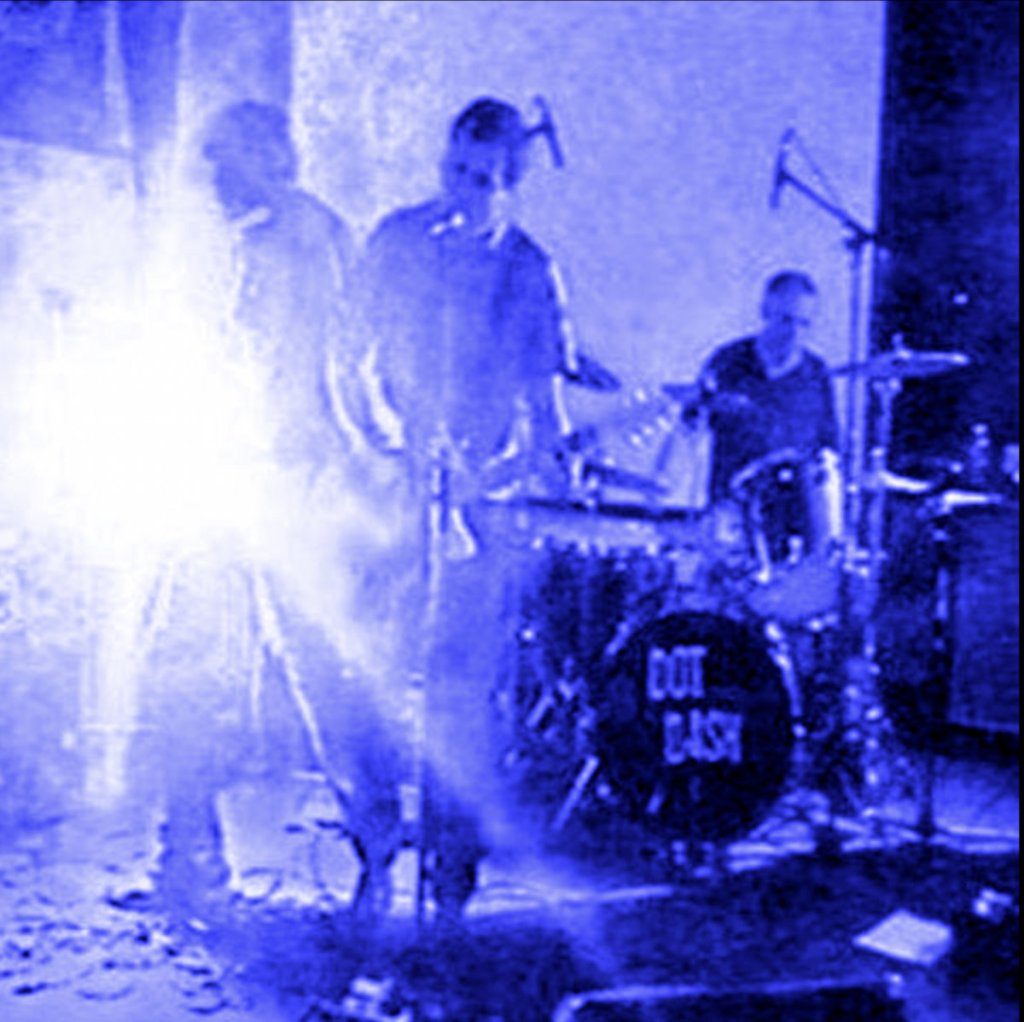
Released on the Canadian indie label, The Beautiful Music, Madman in the Rain is Dot Dash’s seventh album. The band are based in Washington D.C, and the members are Terry Banks on vocals and guitar, Hunter Bennett on bass and Danny Ingram on drums.  

The album was recorded at New York City’s Renegade Studios and produced by Grammy-winning Geoff Sanoff. 

The musicianship is impressive and the band is extremely tight, but the songs are an underwhelming pastiche of various bands that have come before and who have done it better.

According to a Washington Post review, Dot Dash are a “…a retro cocktail that recalls the yearning indie-pop of Sarah Records; the ’80s neo-Byrds jangle of R.E.M., Orange Juice and other seminal college radio artists, and tight, throbbing basslines and slashing guitars that evoke the Jam and the Clash…”

I would be hard-pressed to compare this album to anything that the Clash or The Jam have ever done. There are some 60s jangly guitars, appropriately equipped with the wistful and aloof attitude of Zombies-psychedelia, while dressed to the nines in British-rainy-nostalgia.

But the Clash and The Jam? These are different animals altogether. Nowhere on Madman in the Rain do I hear the furtive anger of the Jam or the cryptic-Marxist wordplay of Joe Strummer. 

You’ve got the mind of a criminal 

And the conscience of a saint

You know I can’t predict the weather

But I think it looks like rain – Animal Stone

While I think a minimalist approach can work with lyrics – sometimes beautifully – this stanza lacks a depth/layer that doesn’t exactly unfold and tell us more. What image is this supposed to paint? On the surface, yeah, it sounds poetic, but it is also disjointed in its abrupt turn halfway through.

The title track does well to slightly antagonize the sleepy  songwriting sensibilities locked away behind heavy walls of British history – a style (perfected by The Kinks) was quaint in ways but usually heavy juxtaposed by social and political conscious writing; bands who sprung out of the deep shadow of Enoch Powell and Margaret Thatcher’s unapologetic and racist economics. 

“Madman in the Rain” as a song title does paint a curious picture of the underdog or the victim of an increasingly unforgiving hyper-active capitalist society, where all emotion has been eradicated, and the creative thinker is left wondering (in the rain) what the hell happened to their purpose. 

I’m not going to assume I know what they intended with this and with their other songs, but it would have been striking to see more connections drawn between this character and his/her/their outside world and to the other tracks on the album. 

Instead, we get an emphatic indifference that can only be matched by the mundane landscape rock n’ roll listeners are trying to escape in the first place. “The weather’s getting wild/the streets are a mess/the light’s gone out of the sky/storm’s coming, I guess.” 

I suppose what I’m saying is, as a fan of great songwriting, I want specifics in writing – I want the writer to convince the listener that only they can say what they are saying.

“Airwaves” has got a great Peter Hook-style bassline towards the end; “Saints/Pharaohs” sounds too much like The Cure’s “Just Like Heaven,”; “Dead Gone” has got an early-2000’s indie vibe thing, showcasing Dot Dash’s ability to arrange a well-crafted song, but the chorus didn’t take me to its potential peak.

Favorite song for me is “Wokeupdreaming” hands-down. The lyrics sound more personal, more original and written with more honesty.

I’m not afraid of dying,

But I’m afraid of being dead

I throw the curtains back in the morning

And at night I stay in bed.

Their style of lyric writing worked really well this particular track, which called for this exact kind of slight nursery-rhyme simplicity.

I would be curious to know how much control their indie label has on the band, if any, and if the band are attempting to write for a very specific audience. Unfortunately, they have failed to convince me that this was an album they wanted to make.

-Drew Wardle

Nonagon’s ‘They Birds’

First off; super geek level esotericism and ages NC-17(?) and up warning. Nonagon is a band forged in the fires between post hardcore, math rock, and screamo in the fertile delta of the Chicago aughts. Since then they’ve adhered to a fiercely dedicated integrity and obsession with writing fantastic short songs with unexpected time signature changes overwrought in complexity so finely worked out they only release about an ep’s worth of these terrific songs every 4 years. As a result, every single production they’ve released since they began warms. our. bones. To hear music that sounds like the constant noise in your head is a transcendent level of empathy that lets you know, there are others just like you! Granted they may be far better at getting those sounds out of their instruments and conveying those feelings, but we’re at least cousins if not straight up siblings. We walk around with a soundtrack of thought in our heads uncannily matched by the music that comes out of specific nearly impossible to discover magical circles and wonder, how’d it get in there too?! Everytime I hear Nonagon that’s exactly what I think (and also fuck I wish I was that good at it but I know I’m not willing to give it as much time and energy as these incredibly dedicated musicians (a term I do NOT use lightly) obviously must do).

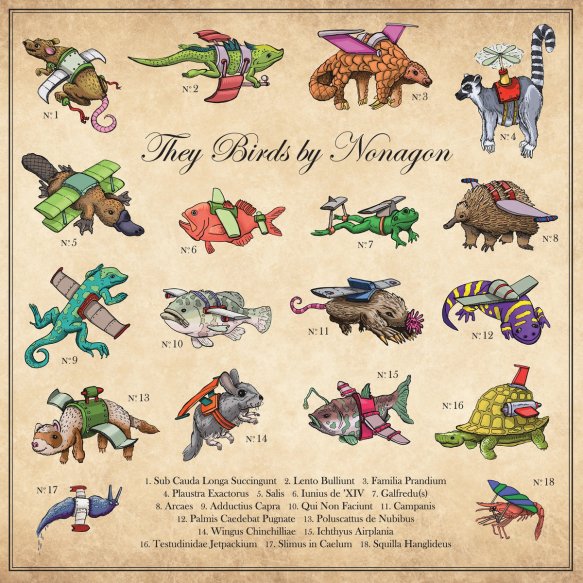
They Birds front cover — now that’s ‘detail oriented’!

Secondly, an important note about Nonagon’s packaging of their releases over the years; stylistically brilliant in the way it… creates a mood (does that sound right to you? Fuck I’m not going to make every word of this article perfect — it’s not like I’M in nonagaon). All of the artwork is produced by bass guitarist and clearly quite accomplished visual artist Robert Gomez. All 3 ep’s and this full album include the signature highly idiosnycratic artwork of Mr. Gomez’s creations. One could write an entire review about the artful presentation of their latest record ‘They Birds’ (wow did it really take me until now to mention the actual title of the record!?) including front and back covers and what appears to be a small hymnal with notes and lyrics all artfully presented alone. All have a late 19th century explorers/biologist’s transcriber vibe that clearly encapsulates a highly abstruse inside joke that only the band themselves understand (for further info read the interview!). Various animals outfitted with rudimentary flying apparatuses (“They Birds”, or the “Magestic Creatures of the Sky”) grace the intricately busy and ingeniously clever cover of the album, aptly foreshadowing what lies on the black circle inside. Point is, if you’re gonna buy this album, definitely buy the record. You won’t be dissapointed. Much as I’d like to write an entire review of the elaborate artwork, you probably want to hear about the music…

This offering differs from Nonagon’s previous releases most markedly in being slightly less harsh and angular. Which, if you’re a fan, you know means it’s still indelibly harsh and angular at many if not most points. However, where previous releases leaned more towards post-hardcore and at times forms resembling what was once called ‘screamo’, the tracks on this album lean more towards more ‘mature’ indie/college and post-rock forms, focussing more on melody than the early ep’s. Passages are often spoken-sung and at times sung, even including parts with harmonies instead of all full volume screams. Which does nothing to dilute the intensity that is Nonagon, but rather increase its dimensions… also the majority of the lines are still shouted at the top of singer/guitarist John Hastie’s lungs.

The album begins with Tuck the long Tail Under, which would definitely be the lead single if they released one. If this were 30 years ago when really good music had an actual chance to make it to late night MTV, Tuck the Long Tail would rival Jawbox’ Savory in its immediate and unique appeal (for those of you under 50, when I and many others saw the video for Jawbox’ Savory on 120 minutes I ran out to buy the album the next day. So what I’m saying is a teenage version of me today would do the same thing in response to hearing Tuck the Long Tail Under, if there were still JUSTICE in the music industry). Similar to all of their works, it’s a beautifully complex piece that really captures opposing harsh and soft dynamics and blurs the lines between them. If you’re a long time punk rock fan this song will definitely make you nostalgic; like a cross between mide period husker du and a midwestern screamo band. Broadly speaking the lyrics describe something that’s been tried and judged wanting. Not that the judges were impartial nor the trial fair; “We misssed the mark. The perspective is slanted”, nor does it stop them in any way “We toe the line to forget what just happened, and tuck the long tail under”. Like a metaphor for Nonagon’s career, unappreciated but inimically brilliant, unceasing, and instead of giving up constantly working harder and getting better.

As much as I’d like to continue a song by song (note by note really) analysis, I’ve been told by my bosses and editors that I really need to stop doing that if I ever want anyone to actually read my reviews. So it’d be fair to summarize Slow Boil as one of their signature unrelentingly complex yet incredibly catchy pieces. I’m guessing the third track, The Family Meal, is going to be a lot of people’s favorite. As touched on previously, Nonagon traffics in a deliciously ecclectic post-hardcore that firmly reminds one of mid nineties post-hardcore DC Dischord groups like Fugazi and Jawbox with fascinating minor key adventures from their regional contemporaries like Minutes. Which sets the perfect tone for this tune about a ‘Family Meal’ at which something, if not everything, is very clearly not right to really fucking disturbingly wrong.

Hack and Salt continue the complex jarring stabbing and sliding motions of intricate guitar and drum work yet contain enough clarity (i.e. not an excess of distortion or redlining in the production) to be melodic and accessible enough to approach June of 44 style post rock (I’m trying very hard not to label them with the largely derided ‘math rock term’, but yeah, that too). Salt in particular has inimitably catchy super complex back and forth series of angular slides.

And whether I consciously or not mentioned June of 44 before getting to the track titled ‘June of ’14’ or whether Nonagon was making an offhand reference to the Chicago math rock supergroup who will ever know? The track certainly bears similairities to a June of 44 song, beginning with a fascinatingly dark and pensive riff on both guitar and bass that spreads out to Shellac/Fugazi like driving rhythms and then proceeds to move quickly and constantly back and forth between the two. It’s also a great example of the unpredictable off kilter drum beats and fills Tony Aimone’s famous for in his approach to odd time signatures and changes.

Jeff(s) is another unpredictable track that begins at a bridge then runs through its many different parts (I lost count at around 6), everyone of which has SO MUCH going on despite there being only 3 members of the band. Boxes is another track which could be a single given how relatively straightforward and catchy the riffs, melodies, and breakdowns are (I hear echoes of, believe it or not, drama club math rock band Faraquet), then ‘Swing Goat’ goes back to the unpredictable type that starts at such a strange angle then transitions seamlessly between complex math rock rhythms and dynamic shouting and slightly sung vocals.

By the Holdouts, it feels as though exhaustion is setting in at a complex beginning, but of course an energetic lift follows. The overall effect is, of course, jarring to say the least.
Bells is a perfect closer, “Set aside but still alive” leaving us in a state of exhausted minor key inertia where “no lung can deny the truth in the lie, son” where we “lose on all sides”.

I can’t imagine what has and continues to sustain Nonagon through all these years without anything approaching the international renown and critical lauding they deserve. Perhaps it’s that every note they put together is an intense labor of love, a struggle with the maddeningly complex and unappreciative bitch goddess of music made with so much fervor, vitality, and sincerity it’s criminal that everyone that truly loves music doesn’t know about it. Or that they feel a responsibility to their work as scientists from an elite laboratory where a rich history of thousands of previous and contemporary midwestern rustbelt independent rockworkers ply their signature sounds in deep underground esoteric niches recognizably steeped in fellow precedents in a language known only to those of us that have intensively studied whatever small pieces of it we can get our ears on. And yet we’re a disparate bunch strewn across the western world — my greatest hope in writing this is that I’ll reach a few more of us out there to let them know that Nonagon’s ‘They Birds’ is something so great that if they didn’t know about the group before now, they’re an essential part of the diet of the kind of music that people like us can’t get enough of. Thanks Nonagon for another great record!

-k. Sonin

Trigger Cut’s ‘ROGO’

Trigger cut is a really good band that plays their professed genre of ‘noise rock’ really well. And I’m guessing they’re a lot of fun to see live. They’ve got their shit together, they know their base well, the guitar is aptly abrasive and catchy in all the right ways, and the rhythm section of Daniel W. And Matt Dumil is unstoppably professional. And god bless ’em for finding my stupid little blog in nowhere New York all the way from Stuttgart, Germany.

But they’ve got a fatal problem, which is that everything they’re doing has been done before. By many different people in many different bands for about 30 years now. Like I said they know their genre (which they proudly call ‘noise rock’ but could easily also be called post-hardcore, hard edged math, or some other variant), but they clearly know and worship it too well to put their own stamp on it.

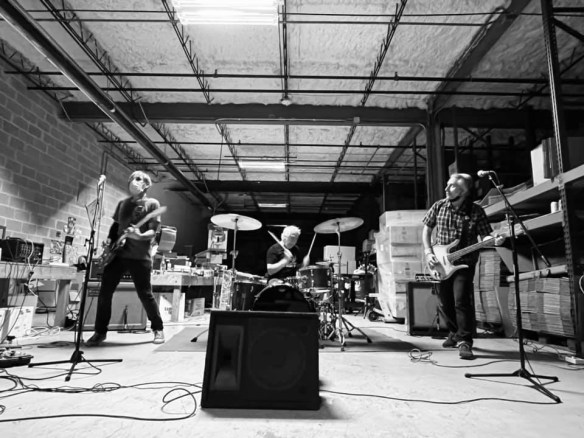
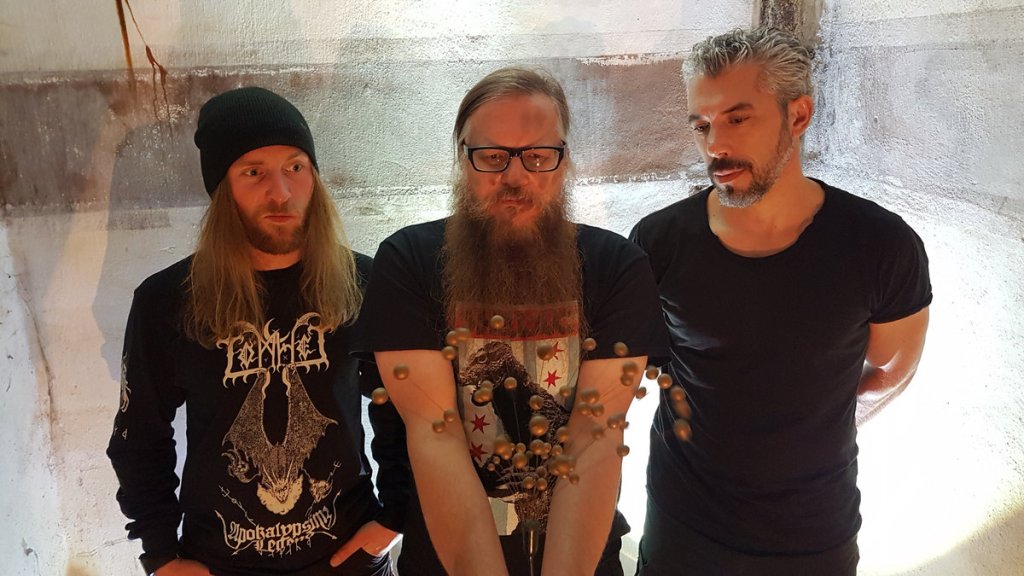
Stuttgart, Germany’s noise rock enthusiasts Trigger Cut

That’s not to say they don’t have specific favorite bands they imitate. Specifically, they are undoubtedly huge Steve Albini acolytes. Vocalist and ‘treble guitarist’ ‘Ralph Ralph’ may not have a voice quite as deep and menacing as Albini, but at times it sounds as though he’s directly imitating every vocal idiosyncracy made famous by Albini (at times there’s also some David Yow). I’d say if they had more of an eclectic style that melded more noise rock groups as opposed to worshipping just a few they might stand out a little more from the pack than they do…

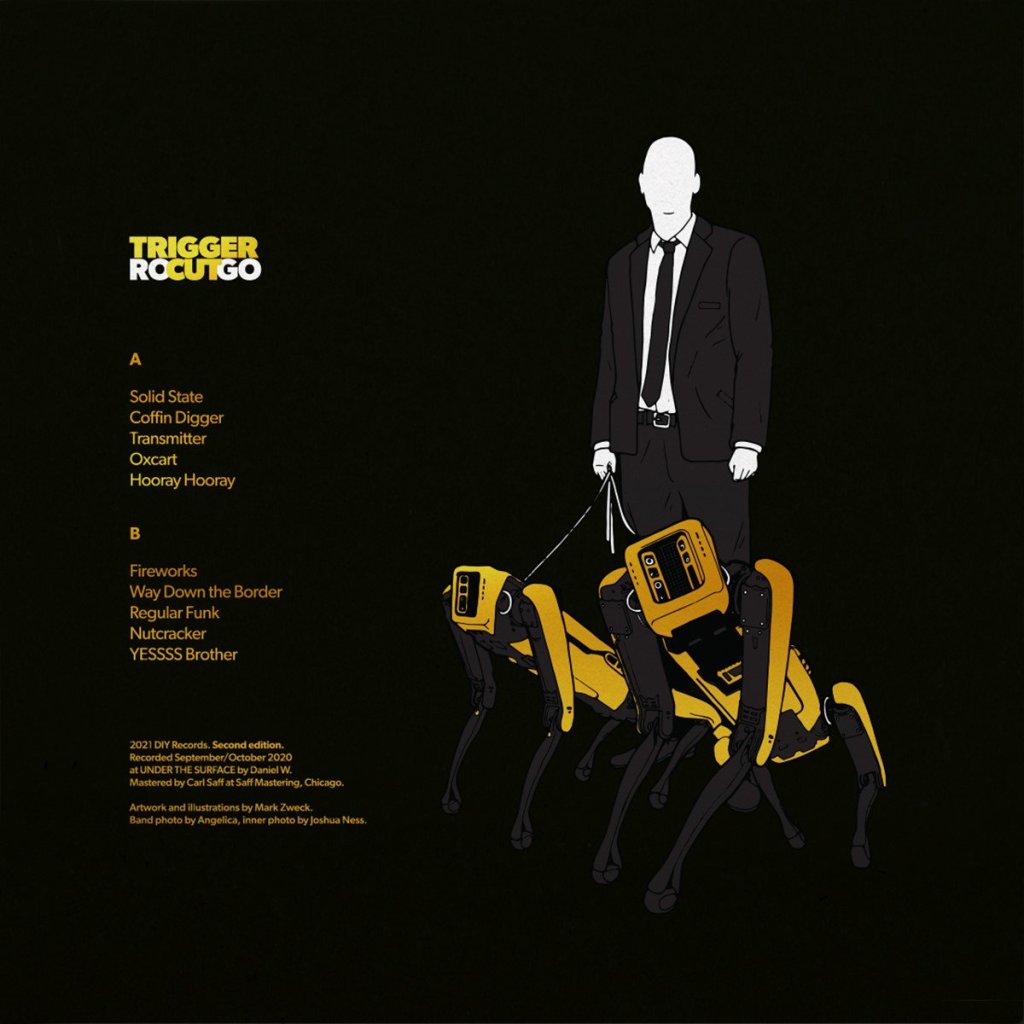
I couldn’t find a lyric sheet on the site, but all the words are in English (why do European bands always sing in English? Seriously?). And it certainly does sound like he’s spewing a lot of Albini-esque sarcastic criticism of everything (I think I can make out something about making fun of Munich hipsters which sounds cool). But the first song starts off with the words “you are so beautiful” and I wondered if this was gonna be a cover of Fugazi’s Margin Walker (which would be have been a really interesting take). But with titles like ‘Solid State’, ‘Transmitter’, and ‘Nutcracker’, I gotta wonder if they like Albini WAYYYYYY too much… He literally quotes lines, sometimes in the voice of the great Albini, like ‘in a minute’ in a Steve Albini voice on Oxcart, or repeating ‘Transmitter’ softly 3 times, than screaming it 3 times more. Wtf is a ‘coffin digger’ anyway? The words sound like they have a good command of English, but without actual lyrics I really can’t tell. It’s possible they cut and pasted a bunch of June of 44 and Shellac lyrics together without regard for meaning other than sounding like good typical noise rock one liners…

Ultra Hip back cover

Don’t get me wrong, this has nothing to do with the fact that they’re from Germany imitating what I’d say is a specifically midwestern American genre and I don’t understand what they’re saying. I’ve heard a number of groups that sound like this from England, from Japan, and now I’ve heard this band from Germany that flew all the way to Chicago to be recorded… and they could be the new say, Mcluskey, STTTNNNNGGG! (or however that’s spelled I can’t even find them on Google anymore), some other British band that sounded like Mcluskey I also can’t remember the name of (but enjoyed in a day so long ago that if I ever found it itd be on a ripped cdr from stolen soulseek files), or any other band that never found their own voice that won’t be remembered unless they somehow market themselves hard enough that people that’ve never heard Shellac or the Jesus Lizard hear them and think they’re brilliant and original.

But the truth is, for now anyway, they don’t bring anything new to the table. Especially to people like myself that have been listening to noise rock genre bands for thirty years now and have heard hundreds of bands like them from everywhere. Which is not to say there isn’t plenty of room for originality within the genre or that there aren’t innovative bands around the globe; Ottawa’s Metz is relentlessly driving and at times too abrasive to listen to but similar enough in song style that you get used to the abrasiveness. Atlanta Georgia’s Whores. (combining noise rock with a rich vein of sludge) is beyond intense and has endless rage for every minute they have to be awake. London’s Hey Colossus is incredibly diverse and unpredictable. There are plenty more examples of noise rock groups that are doing innovative new things with the genre. Trigger Cut really just needs to get in touch with what they can do with the by now well trodden 30 year old genre that no one else can, or they’re doomed to remain in the pack of good, hardworking, adherents of the genre that are such huge fans that they’re practically a cover band.

Thanks for the album guys. You’re a great band and I hope you find your voice someday, but on this album it sounds like you’re using someone else’s.