pMad — the “Chance” single and “Trust Devoured” ep

We belive the pMad is a young, new group with a significant amount of potential. However, as they sound now, to us they have an inescapable fatal flaw. If you’ve read my reviews you know there’s one thing I hate above all else; auto-tuned vocals. It’s what separates the production I hate from the 21st century from the music I love, most of which is from the 20th century. There’s an easy way to remedy this, however. And that’s to use vocals that are only affected with twentieth century effects and/or pedals.

Otherwise, you’re going to get that garbage Kanye West (and every other pop singer from the last 25 years) pitch corrected sound. Which means you sound like a robot. In a way it levels the playing field because anyone can SOUND like they can sing and are on key using this and other digital effects. But to me, in a more important way, it homogenizes everyone. And as if the use of AI to create whole songs and albums on platforms like Spotify where they often go unnoticed wasn’t bad enough, vocalists like pMad’s make themselves sound like robots thereby pre-eliminating their individuality and humanity.

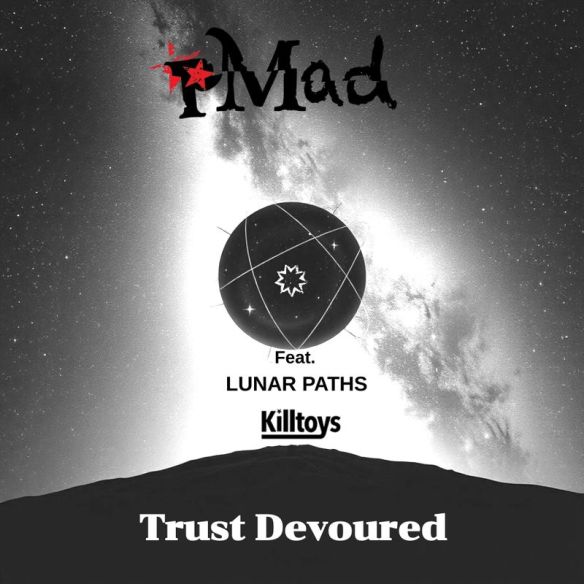
Other than that, pMad is what it advertises to a degree. The sounds are informed by the post-punk/early Goth genres of the late seventies and early eighties. Another respect in which pMad differs, however, in another way I don’t like, reminds me of the scene in 24 hour party people where the narrator indicates “something equally epoch making is happening…They’re applauding the DJ. Not the music, not the musician, not the creator, but the medium.” pMad fits better into this epoch of New Order than that of Joy Division. Their songs are remixed. They utilize the designs of other artists for rhythm tracks –which makes it confusing as to who I’m actually listening to and reviewing — the “Trust Devoured” ep features two other artists, in what pMad calls “a boundary-pushing collaboration alongside UK/USA’s Lunar Paths and Australia’s Killtoys — a unique musical venture that brings together 3 artists from across the world to create something greater than the sum of its parts.”

We know there’s supposed to be a degree of talking up the music on the record in press kits and oftentimes a label or marketing agency writes it as opposed to the artist themself. However, in all the materials sent to us they mention this “Exquisite Corpses” (which if they were to do it correctly i.e. by the ‘Exquisite Corpse’ member of the Zurich dada collective very early in the twentieth century they’d have one word from one artist followed by another word that’s blind to the first word from the second and so on, or at least alternating lyrical lines) project several times as if it’s the Bees Tits. And it all comes off as, well, pretentious. As do the lyrics in general which are not, disappointingly, abstract, conceptual, or Dadaist in any way shape or readymade. They’re more like a teenager’s journal of despair. It’s possible they’re very young, it’s likely that their band is very new anyway.

Hopefully they won’t take criticisms like these to the detriment of their ‘souls’ (we’ve always wondered what it’s like to have one of those) but will rather use them as an opportunity to see where they could improve AND where they draw the line and say “Times Boredom’s critics SUCK and they’re all wrong about the vocals!” (it’d be nice if they’d get mad instead of just continuously sing speaking the same downbeat melody over and over — it’s almost as if they need all the digital effects they’re using to make the vocals stand out and be entertaining…)

We honestly didn’t want this review to be dumping on them as much as we clearly have (sorry), because the music’s really not bad. It’s actually pretty enjoyable in the drone heavy style of unemotional depressing tunes. The best parts of pMad are those that remind us of Joy Division and early The Cure. It’s quite possible that if the vocals made less use of digital effects (you can hear a little less on ‘Closer’ — it sounds like it might be a direct reference but it is indeed meant to be CLOS – ER, not CLOSER as the 2nd and final Joy Division album cleverly is), the single and the ep would be far more enjoyable. It’s not necessarily or undeniably bad to use digital effects and make yourself sound ‘closer’ and ‘closer’ to a robot, it’s just something that I personally don’t like. It can ruin what would otherwise be a pretty good tribute to early post-punk and goth… and for me, it has.

Not to mention the marketing on their website rubs we noncommercial not for profit democratic socialists all wrong. Having merch is one thing. Having beautiful people models display the wearable merch? And all the emphasis on the logo and branding — just no. Not for us. No.

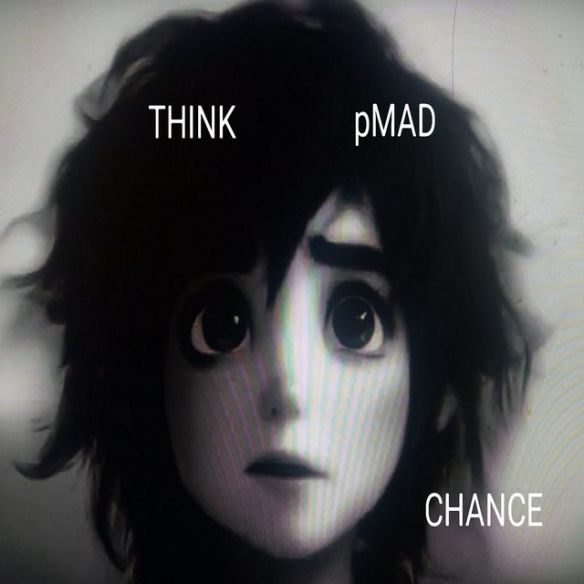
Hence if it sounds like dumping. I apologize; but I really can’t stand vocals that are affected in this machine like way to the degree that they are. I can’t get past it. I hear the tunes underneath and somewhat enjoy them, but the overaffected vocals are a near constant presence on both the “Chance” single (another collaboration with a different artist Think- Marco Menazzi — again, how much of this is pMad and how much the other people?) and the “Trust Devoured” ep.

Perhaps it’d be useful to constructively delve further into the Chance single. The tune and the energy are great, jaunty even where the ep is far more droney and dark. However, due to pMad’s insistence on collaborating with one or multiple artists on all of their tracks, we don’t know how much of this is pMad and how much is Think — it stands out as a very different track then the ep which leads us to believe the other artists are writing more of the basic songs then one would think since the pMad name is clearly stamped (and sent) first.

-A ‘collaboration’ between Scott Koenig and artists/procurators xxStevexx, Keith, Kasreal, and Jessica

Wonneschauder by Quitt

I must admit it’s refreshing to hear a foreign band performing their songs in their native language as opposed to English. It also means I won’t be able to understand the lyrics — oh well, a dimension of the group I won’t get to experience nor have to write about… too bad. We did, however, look up the translation of the title. If we googled correctly, it’s something like ‘Shudder’. Cool.

Lo-fi adjacent (the production’s too good to be lo-fi but the music and spirit thereof certainly are) and post-punk/hardcore/rock (the latter qualifiers should be made given the much lower intensity of Quitt who are influenced by other similarly less intense but no less post-hardcore groups) group Quitt are from Mainz, Germany. However, like so many other European groups that send their record across the pond to be reviewed, they seem to share a good deal with older American bands.

Begs the question — do groups that enjoy/are trying to sound like American bands just get overrepresented in the small sample I have because they sent it to me because they want to be reviewed in an ‘American’ zine blog (whatever my site and other similar sites are called)? Or do European groups in general take their cues from American bands?

I can only answer this in terms of larger scenes I’ve heard of and studied a bit; namely a few in England. Groups from and around London seem to have a greater appreciation of American noise rock then most people over here do. I’ve heard a large number of bands trying to sound like Shellac, Big Black, and the Butthole Surfers. But also plenty that mold these influences with others, some of which are European, or at least started in Europe and were mutated back here in the States for export to, ironically (just like punk rock and NYC), back to Europe from the US’s perversion of its European roots. These groups are darker and noisier, often experimenting with dark screechy electronics a la Black Dice. To oversimplify (and extrapolate from a decidedly statistically unsound, unrepresentative and not the least bit random sample) from what I’ve heard, there’s a plethora of groups in Europe that take most but not all of their cues from underground American bands. Embarassingly, many have a deeper understanding and love of our noise and post rock groups. Certainly more so than the average American listener who’s never heard of 95% of our underground music nor genres.

Quitt, on the other hand, is much harder to place. They certainly sound like American groups, but no one in particular. In addition to the PAvement and SEbadoh influence that come through most strongly on Keine partys (One parties?), there are other great American influences highlighted on this record. Mondo (Im Warenstrom) sounds like a lost Archers of Loaf track (and certainly wouldn’t be out of place on any Merge records compilations), but it also has riffs that remind us of Fugazi. And Fugazi’s influence is even more evident on the next track “Kein Sperrmull”. Dirty as that title sounds, it actually translates to garbage that’s too big for the municipal solid waste stream. So… kind of what you think it is? Maybe (chuckle chuckle). The last track, Vertiko again has strong Archers of Loaf vibes. At this point it’s clear Quitt has a consistent, authentically idiosyncratic sound.

Despite the groups I’m referencing and that I hear the influence of, it’s just that. Quitt’s not outright aping or copying any one group’s sound. They’ve melded them into something purely their own. Again, it’s just surprising to me that they have so many American influences. Granted the only German ‘rock’ music I know is krautrock like Can (sorry is that an offensive term? “Can”? ;)), futuristic machine music like at one end of the spectrum Kraftwerk and the other Neu! And of course the dark nihilistic stuff like Einsturzende Neubauten, but also underground doom metal like Ahab (who also sing in English — for what reason we don’t know since I can’t understand half the words in English anyway). Quitt is very different from all of these groups and clearly takes their cues from elsewhere, then gets to their finishing point all on their own.

Everything they write is eclectic enough to be original and innovative on their own terms. Obviously the fact that they sing in German makes a lot of difference. But we’re overwhelmingly, pleasantly surprised that they never use their own language to convey the kind of industrial darkness we in the US are used to hearing from self exploiting bands like… Idk who’s that band that sang ‘Du Hast Vich’ — nevermind even if I knew it I wouldn’t want to pervert this review with the shitty group’s name. Or imported acts like KMFDM. Even excellent groups like Einsturzende Neubauten seem to rely on the German language to convey frightening or just plain evil sounding vocals.

Quitt, on the other hand, uses their own language organically. And they back it up with a whole host of American underground sounding songs played excellently and written expertly. I can’t overstate how nice it is to hear a group that was clearly influenced by American music singing in German without utilizing the language in a cliched manner. And, much like most of the bands I like, there are extensive instrumental passages without vocals that highlight the music behind the melodies but manage to never show off or sound like that blight on humanity, the ‘solo’.

It turns out the only thing wrong with this ep is how short it is. Which obviously isn’t a shortcoming because it’s an ep. But at just around twenty (you could’ve at least given us thirty??) minutes spinning it does always leave me wanting more. So I spin it at least a couple times to feel somewhat satisfied — and sounds better on every listen. Feel free to send any records you make in the future our way Quitt. Thanks!

-Jessica Goldstein

Vacant Pavements’ The Cost of Complaceny

Another submittal, another bizarre European entry from a highly produced but unimpressive group going nowhere.

They caught our attention because of their mention of gothic/post-punk influences we love; that familiar Bauhaus, Joy Division, The Cure goth grandfathers trio. Granted we haven’t really moved on since then, nor have many of our Gen X friends and colleagues that are happy to continue looking for ‘deleted Smiths singles’, as they play the first 3 Cure, 3 Joy Division, and the five or so studio records by Bauhaus ad infinitum (and of course as purists they’ve got the first few New Order, Love and Rockets, and all the later Cure records but they don’t really get much spin), however, we’d think a group from Glasgow Scotland would have. There should be a whole laundry list of obscure British goth groups since then, even those that may directly ape the 3 grannies, that they know about but we don’t. Or maybe this is just their way of trying to relate to what they think we might actually know.

In any case it doesn’t work. They don’t even sound like a poor man’s version of any of these greats. Their music is twenty first century production and perhaps seventies post punk vocals. They’re probably trying very hard to write seventies post punk melodies for their vocals, but again, not working. Some of the tunes border on the interesting, like the instrumental ‘The Core’, but it’s more of an electronic noise curiosity than what they’re trying (or say they’re trying) to do.

What is interesting, at least in theory, is the fact that all the songs on this their debut ep are about Chernobyl. However interesting the subject might be though, this isn’t anywhere near as good as the mini-series that came out a couple months ago. There’s no real insight or genuine emotion from the lyrics (that are clearly about Chernobyl themes)… witness for example ‘Caesium 137’. No we don’t know what that is and honestly we’re not going to look it up because we’re sure we’ve heard about it at some other point and it’s a contaminating isotope that resulted from the Chernobyl meltdown fallout (sorry, we know no ones really sure if it was a meltdown, an explosion, or… who knows — write about that, the mystery, the uncertainty, the fact that some of the people that worked there were denying anything at all happened up to the point — whatever. We’re not doing your homework for you. Just saying that while the subject matter is interesting, what you’ve written about it is not. You can’t just take some really dark subject matter, sing about it with downtrodden goth vocals and expect it to be anything).

And then there’s the clearly trying to be their ‘Love will Tear us Apart’ “Pripyat Love Song”… this ain’t that. Even if they’d done it first, this wouldn’t have claimed any place in that zone whatsoever. It is, instead, a poor imitation of a classic that sounds more like a song that was written by The National (I can sing along ‘nowhere I thought I’d be by now my head is a buzzing 3 star hotel’ easier than any actual post punk song) and backed up by a slowed down Depeche Mode track… btw it’s ok to admit you like Depeche Mode at this point. Point of fact we’d respect you far more if… ah not worth the ‘ink’.

It’s entirely possible that someday this will be their embarrassing debut wherein they tried to ape their heroes on their way to honing their own sound. Even in that case, however, if the lack of songwriting talent evident on this ep continues, their original sounds will still be marred by, well, suckage. Sorry kids this ain’t doing anything for me.

-xxStevexx

The Junks’ Control and Abuse

If you’re interested in reviewing a bunch of obscure some of which are really good some of which are garbage most of which are how did you get our information — seriously, e-mail Timesboredom@gmail.com to join our team. We’re looking for a few decent writers, because for some reason lots of people want to be reviewed by us. There’s probably some sort of industry reason (maybe all European groups are desperate to have any reviews from the US); in any case we’re happy to get to explore and hear about all kinds of girls. That was an inside joke no one’s gonna get but us (join the team and we’ll let you know what it means!).

This is interesting; here’s one from an alternative rock trio in Rome. I’m sure someone else that’s as educated as I should be knows the answer to this; but why do all these European groups sing in English? Is that perhaps the secret — they’re trying to reach US audiences because that’s where the money is hence a review in a US zine would be tits…

Fortunately for them we do review pretty much everything we get that’s not offensively bad. Unfortunately for you readers (and perhaps The Junks because we honestly don’t know what they’re looking for), when we get bored we do tend to ramble…

And this music is boring. They’re not wrong in sending it to us as nineties alternative is likely to tickle our fancy, but it’s as though they have the wrong influences from the 90s or write in this vein in such an original or eclectic style it doesn’t do anything for us. And of course if the songwriting were really good we’d probably like it anyway — it’s clear the songwriting on Control and Abuse is good, but not really good. Certainly not good enough for us to sing the praises of an Italian (sorry, maybe they’re from the part of Rome that’s not really Italy — Vatican City maybe? — we Americans are notoriously dumb when it comes to geography and history of the old worlds) band that we’ll most likely never hear from again and probably got here by sending a blast of the same email to hundreds of US websites.

If you’re still interested (I’m guessing no one other than whoever sent us this The Junk’s record possibly is); Control and Abuse is a pop record that’s slickly produced. The band’s good enough that they could genuinely be a Runaways/boy band type combination of a bunch of great Roman scene musicians… not much info is forthcoming, other than that they’re an “alt-rock trio with folk and electronic influences”. I don’t hear any significant degree of either of the latter descriptions.

The record is rather a doldrum combination of Beatlesque songs most of which are typically downbeat; there are exceptions but songs like “Can’t Be Sad Like Leonard Cohen” are so transparently an uninspired group that decided to write a song that sounded like Leonard Cohen (perhaps this is the ‘folk’ to which they refer) but they ‘weren’t sad enough’. And while they’ve obviously heard plenty of nineties alt rock, all I hear is the Beatles influence on Nirvana coming through; similar to international groups that aped grunge twenty years ago only to end up sounding like Black Sabbath and Led Zeppelin without the filter of American punk rock or hardcore.

We’d go on, but honestly they haven’t earned a review by our hand. Honestly, we’ve probably skipped over better bands. And if we hadn’t begun writing this as we listened to the album (we didn’t even make it the whole way through honestly) we probably would have/should have skipped this one too. Sorry The Junks, your made for tv alternative rock doesn’t sound like anything authentic from here nor does it include any Roman influence to make it interesting enough to put your spin on our popular music from the nineties from over there.

-xxSTevexx

Michael Ellis’ Modern Heresy

At this point we should probably just create a category, tag, or whatever for ‘no idea how we got this but we like it’.

Copenhagen Denmark’s Michael Ellis (note; not the name of a person but a group with some very spooky mystical origins) plays a variant on the familiar math/post rock sound that arose in the nineties in the US simultaneously in the Midwest and the northern part of the south (scenes sprung up of course quickly soon thereafter in California and New York sometimes consisting of a single group or an incestuous group of groups trading members of the ‘post math rock exchange’).

Michael Ellis themselves, however, are part of the international post math boom that proceeded the initial springwell within the US. Upon hearing the first track of their new lp, one might even think this was an AI picking and choosing yet in some ways aping the overlords and most technically impressive of the international intersection of what’s become the crossroads of math rock, post rock, and post-metal.

We’ve written extensively on the subject of what we’re calling post math (but which most would simplify into ‘math rock’ in which case they wouldn’t really be wrong but they’d be missing something); penning the particularly popular and illuminating ‘dichotomy of math rock’ in the early aughts. We wouldn’t say we’re experts, having only experienced a few key live performances (post breakup Polvo being our most infamous and enjoyable), however, we have been following and critiquing the movement since its early days.

Therefore we feel we are at least somewhat qualified to comment on the international development front. We’ve followed some of the groups from Japan, England, and New Zealand. What seems to be happening in general is what we warned about in our ‘dichotomy’ landmark piece (yes we are being sarcastic about our overqualifications and importance in the critique of this genre if you hadn’t caught on by now); the importance of professionalism and talent when it comes to the genre as opposed to experimentation and serendipity. The latter of which produced the likes of groups like our beloved Polvo, who were just as much lo-fi and noise rock like their contemporaries Archers of Loaf as they were talented purveyors of a new science of time signatures and post-prog it might have gone in this direction second guessing of classic rock’s many legacies.

Seminal groups like Breadwinner and Craw took the post math genre in new unbelievably weird and intriguing hybrid directions; in other ways the ‘post’ of post rock took over and the influence of instrumental chamber groups like Godspeed YOU!!!! Black !!! Emperor waned supreme.

Michael Ellis in a lot of ways is evident of the culmination of the ‘classical’ era of post math; one that seamlessly blends the post rock and math rock formats and enjoins it without irony or apology with professionally crunchy post-thrash metal. Plenty of groups in the US took the angular riffs of post math to dizzying new heights (Hella, Mars Volta), and Michael Ellis’ latest lp includes a healthy dose of these in spades as well. From the first notes of Modern Heresy it’s clear you’re dealing with auteurs here to say the least, versed in everything from the climbing arpeggiated maddeningly complex rhythms of Sweden’s Meshuggah back to the fusion of Miles Davis’ Live Evil and Bitches Brew and specifically the guitar work of John Mclaughlin as a shadowed but undeniable giant influence.

So to go over each and every track would be, in our opinion, to exhaust our knowledge of every influence, riff, and extraction in a way that would be undeniably even more boring than what we’ve written thus far.

Suffice it to say that Michael Ellis is formidable force in current international post math (they describe the influences as being from math rock, ‘heavy metal and game soundtracks’. They also as mentioned previously claim a mystical origin and perform in full regalia such as ‘suits and masks’, or martial arts smocks. Their kung clearly has fu. Despite their sound and the fact that, did they wish, they could take themselves way too seriously and would probably not even be too pretentious in doing so, instead they choose humility and humor. While at points such as the track Myrmidon they risk just that of pretention, they claw its ambitions back enough eventually that it’s clear they are genuinely just jamming on shit they like.

At this point the kind of instrumental every point and rhythm must be interesting and not repeated for more than thirty seconds Michael Ellis doles out is still entertaining and fun. But at some point we’re pretty certain groups like them will be listened to and remembered similarly to the Jeff Beck group. Your guitar or drumming teacher was really inspired by these guys and the heights they took the genre too, but they’re an obscure international group who you can find on Spotify, but only by sifting through all the other artists named ‘Michael Ellis’ (it really is strange that they’d choose such a common though from what we can tell completely irrelevant name) and looking for the kind of shit your teacher has recommended to you before while extolling the virtues and vices the overruse Jerry made of the mixolydian mode and how it really killed… whatever.

That being said, I genuinely hope they’re creating and performing this music in good will and more importantly, good humor. Because this is highly technical specialist supergeeky super savant music at this point. Executed flawlessly and with as many winks and nods to Don Cab as King Crimson, this is not very original nor distinctive. But for now, even twenty years after it was developed and 15 after it was perfected to the degree Michael Ellis continues, the unusually original AND distinctive genre of post math has the kind of power and entertainment that, to a geek like me, will bear repeated listening and enjoyment of. Thanks boys for your contribution to my undead love of this kind of music in this kind of genre — whatever it should be called — we’ll know it when we hear it twenty years from NOW.

Dictated but not read by Jessica Goldstein

Girls In Synthesis’ “Die Leere” ep

I think we said this again recently, but we’re completely baffled as to where international artists get our contact info. Nonetheless, we’re always pleased to hear all kinds of noisy shit from… wherever.

According to the press release they sent us, this short ep ‘Die Leere’ is Girls In Synthesis follow up to their full length album ‘The Rest is Distraction’. And it’s much different in a number of ways that we wouldn’t know b/c we haven’t heard the initial lp. The PR then goes on to describe a laundry list of differing factors in terms of the atmosphere of this experimental noise release AND a laundry of genres they should be most associated with AND existential factors they explore on this new ep. The whole thing reminds me of J. Eric Smith’s old assertion that ‘these bands are barely out of the garage and they’ve got a host of theories on what they’re doing, going to do, have done, beliefs, philosophies, etc.’

See first paragraph for explanation — we may not be as sophisticated or have as much sophistry (is that a word?) as our contemporaries across the pond, but we’ve got our ears and our formative years. We listened to the ep. With the exception of the second track (a ‘dub’ of the first and the 4th “Against the Seething” we wouldn’t call this experimental noise music. We’d call it kickass post-punk noise rock (deathrock’s fine too, we don’t really care to put too fine a point on it — that’s for real music critics to do).

“I know no other way” is like a lo-fi Peter Murphy track meets some obscure punk track from The Sound. Solid track through rhythm section sets the base for what is essentially an all out assault of guitars and sing-screaming on the sense that everything’s ok. They put it more intellectually as ‘the physicality of human anxiety’ — again, we find ourselves in a situation where we’re made to feel like Americans and say ‘ok dude, whatever you say. We THINK we hear what you’re saying, and we like it.’

The follow-up dub is pretty much what you’d expect of what a post-punk band would call ‘dub’; essentially an extended remix with a lot of effects and isolated passages.

‘Sinking Feeling’ again reminds us of old Bauhaus/early Love and Rockets, and another driving noise variant therewith that is very similar in feeling to “I know no other way” though of course the melody’s different… in a way that probably wouldn’t be noticed by the casual listener. In addition to the lightning paced delivery of English accentuated heavily affected sing-speak-screaming common to a Bauhaus track like ‘In the Flat Field’, one may also relate this far more contemporary track to some of their more contemporary, very popular peers across the pond like Metz that are creating driven hard hitting post noise rock in a similar vein.

Not the case with the final track “Against the Seething”, a rather uninspired take at perhaps an ancient Cabaret Voltaire or Throbbing Gristle track that I typically would skip. A simple though intense pulse of synthesized noise bass lines and highly e(a?)ffected higher register lines accompany what sounds like a reading of a poem in a night club. It is intense but, again, in a way that doesn’t interest me more than once.

An interesting if mixed follow up to an album we’ve never heard and a band and/or promotional company (because these things often go the way of an overenthusiastic latter the former knows nor cares anything about) that’s a bit too into defining themselves for our taste. If they drop the pretention they could have some really good singles…

Hozomeen’s “The Void” LP

We don’t know how or why, but we often get requests from England and New Zealand. We’re flattered, but, as we try to warn, when reviewing our locals we give them the benefit of the doubt (mostly b/c we want free tickets and vinyl and t-shirts), but we hold national and international artists to a higher standard.

You’ve been warned.

Hozomeen is Graham Thompson and Graham Thompson, we assume, is Hozomeen. He writes and performs in various groups in the Newcastle upon Tyne area of England that we assume are in the noise rock vein/genre (because we have expressed our affection for that kind of music from that particular area before).

Based on the description we were expecting Hozomeen to be far more arty and less enjoyable then it is. To be blunt, it ROCKS. In the way that say Whores., Shellac, Jesus Lizard, and other rhythmic noise/sludge rocks. There are cogent, sludgey riffs. There is loud sing saying. There are noisey passages on fairly traditional rock instruments. It also approaches earlier variants of post-hardcore and sludge such as Quicksand and Helmet.

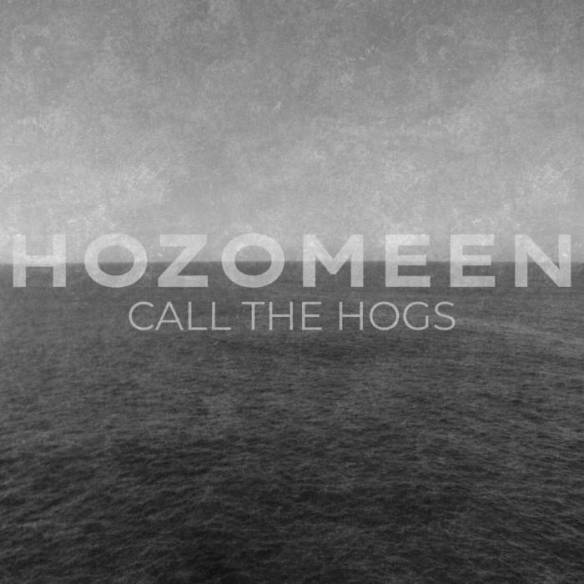
Each song on the LP released as a ‘single’ is accompanied by a similarly haunting and empty slightly different colored image with its title printed on. Like so;

It begins with Laughter. An evolving piece of feedback, uncertain drums, muddy quotes, and the dulcet tones of a banjo. From there it launches into The Hogs, a driving sludge-noise masterpiece, complete with loudly sung-spoken vocals. Then on into the instrumental Lack, a tricky rhythmic piece of post-hardcore that goes everywhere you don’t expect it to but really should. Coursing takes us further down the ride of post-hardcore noise, enticing with atonal arpeggios and straight up harshly isolated tribal drumming, heading into all out chaotic frenetty (no that’s not a word, we made it up. It works here. Trust us).

One Kilohertz teases like an old Unsane or newer Hey Colossus song; it really is impressive how Thompson gets a really full noise band song playing as he is each instrument solo (or so he tells us). The vocals come on like Part Chimp or intense Tool, Torche, or some other metal hybrid that’s sung shouted right on key.

The Balk moves on in Whores. vein, all low end, and a few Jesus Lizard/Denison type arpegiatted fifths for good measures until it erupts into wails of guitars and horns screeching. Cleansing breaths wouldn’t be out of place on a mid period Polvo record, with its dulcet celestial tones, dry as a bone atmosphere and creeping rhythm. The rhythm picks up and creepy loud breathing emerges before a wall of dissonant single note guitars play a slow transcendent metal passage, at which point the rhythm settles in and riffs wail and wallow you into a lull. You leave the arena with distorted drums, bells, and whistling feedback.

Manifestation of Grief is the final slow death march of low end feedback giving way to organ like wails of effected guitars and synths, followed by a harrowing passage of gloom and spoken words that wouldn’t be out of place on a Planning for Burial record.

Songs tend to be on the, shall we say ‘prog’ end of the time spectrum; clocking in at a minute to 8 minutes. And the all go on for only as short or as long as they need to, never letting the listener down by (as so often sludgey noise does) repeating a passage too long or not giving birth to a new direction.

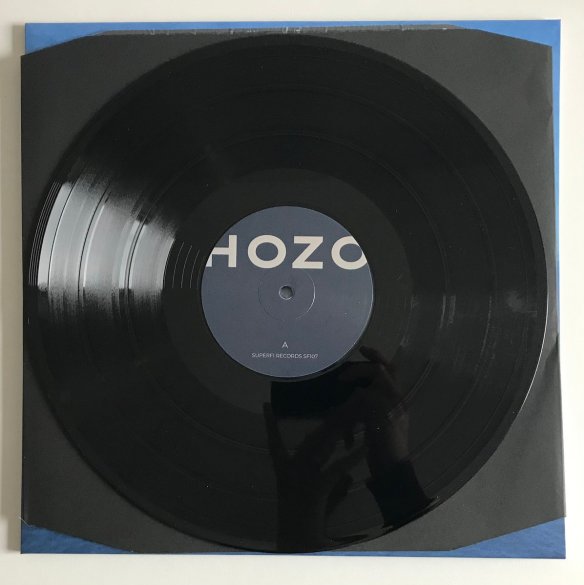
In short, despite our warning, we LOVE this record. The atmosphere, the gloom, the precedents it takes its cues from, SUPERB. We look forward to hearing more in the future; too bad the limited record’s already sold out (we REALLY need to get to our reviews sooner from here on out!) This is why we do this.

Ampevene’s ‘The Chemistress’

At some point artists started releasing ‘singles’ again. I mean, we know no one ever really stopped, but we’ve been used to what used to be called ‘album oriented programming/AOP’ or ‘album oriented rock/AOR’ for ourselves since, like, the seventies man. Yeah, we’re that fucking old.

Recently though artists and groups have been sending us ‘singles’ to review and we’re a little out of sorts. I was thinking about it and I was gonna send it back and ask for at least an ep but then I was like, no wait, this is really easy. I can write like two lines and still be technically getting back to the group — right? We cool guys?

Anyway. We’ve heard of Ampevene and know they’re a local Albany band but never really heard them. So we were glad to receive this request to review this single — albeit years ago — but as we keep saying we’re going through our backlog now or whatever. And EVERYTHING WE ARE REVIEWING ARE TIMELESS CLASSICS SO STFU!

Ampevene may be Albany based but they’re clearly a group that sounds like they’ve got ambitions, chops, and productions for more of a nationwide audience. I’m sure they get this all the time but they sound a lot like that band that Omar Rodriguez Lopez formed after At-The Drive In… what was their name? Oh yeah, the ‘Mars Volta’. They took what ATDI was doing and took it… frankly a little too far into the prog stratosphere for me. As does Ampevene (not saying we don’t like it or think it’s good just not necessarily our cup o tea — we’s more post-hardcore than post-hardcore-went-prog). They list influences like Lopez, Miles Davis, King Crimson, TOOL… you get the idea.

They’re clearly quite talented. They’re also in what’s probably now an outmoded style, though I think I remember even Sleater Kinney was getting into it back in the early aughts… I don’t know whether to call it post-prog, but that’s pretty much what I hear. If not that then retro-prog, neo fusion, post classic rock, etc. Made by musicians that have clearly honed their chops and studied their precedents.

It’s pretty entertaining. Pretty wild, out there, psychedelic. And I’m guessing it’s a lot of fun to watch live, “keeping spectators on their heels from their improvisational clash of metal and jazz.” as NYS Music put it.

To me, this single could be from a Led Zeppelin record or a Polvo record. It clearly blends genres. Even though it can clearly be placed within the sphere of a few genres, it’s not predictable in anyway. It turns on right away. No intros, no lengthy instrumental passages, no letup. It continues in this vein for the entirety of five and a half minutes. Many of the lines are sung-spoken but then there are a number of melodic passages that come one time and are repeated a couple or a few times but then aren’t repeated again; as a music critic I can’t overemphasize how interesting this is. It really doesn’t happen a lot. It’s interesting and atypical.

However, so’s not to give Ampevene too swelled a head (though they may deserve one that’s really not what we do here at the Boredom), there are a few passages that do predictably slip into classic rock riffing or lean too heavily on the Mars Volta/Radiohead type overreliance on the bleep bloop of heavily laden effects.

But overall a very worthy and interesting single. We hope it was a hit (we don’t really listen to the radio). Good luck fellas. Give us free tickets to your next show and we’ll be there!

Nathan Meltz & the House of Tomorrows’ “Sings More Songs about failed utopias volume 2”

Doesn’t really roll off the tongue does it? I’m guessing that’s on purpose.

We’ve discussed and reviewed Nathan Meltz before, a force behind several groups in the local Albany/Troy underground pop collective. The title of this record is a sequel to the equally good pop record ‘Sing More Songs About Failed Utopias from 2022’ (which we reviewed back then at https://timesboredom.com/2022/10/29/nathan-meltz-and-the-house-of-tomorrow-sing-more-songs-about-failed-utopias/). This one was released in 2023 — please forgive the lateness of our reply.

Like its predecessor, this record is full of quirky lo-fi pop goodness. Catchy and well produced for a lo-fi record; it’s got that classic trying not to sound too polished that’s starting to sound pretty damned polished at this point but still doesn’t have to use any autotune or other omnipresent crap on most twenty-first century records.

Nathan as often is joined by other luminaries of the Troy scene on this record that make up his ‘HOT’ (House of Tomorrow) band; Kim Tateo, Brady Potts, Chris Brown (we know him!), Dan Prockup, and Connor Armbruster (who DOESNT know him — say Connor when are you sending us a record?)

Tackling issues from the Source Family to Emma Goldman (we’re guessing Nathan’s been watching some documentaries), everything is couched in the classic House of Tomorrow pop hooks that get richer and catchier with every listen. And lots of making fun of hippies in a not so tongue in cheek manner — ‘The Farm’ is clearly about an old school sixties farm collective

“Come down to the farm in Tennesee
Communal cosmic energy
Smoking dope dropping LSD
It’s better than Haight-Ashbury!”

This song reminds me of Smog making fun of crummy punk bands in the nineties; but Mr. Meltz clearly has no boundaries for how old or obscure the source material for his ironic humorous songs are. Even far back to where some Phish fans unfortunately really do still live.

Meltz also bears many similarities to his fellow pop auteurs in the Troy area; specifically one can’t help but hear the influence of the seminal Jason ‘Wolfman’ Martin. But his songs are also clearly rooted in the eastern Massachusettes lo-fi indie rock scene like Sebadoh, Sentridoh — you know, lots of stuff Lou Barlow and people that like him are associated with. And Smog as we mentioned before, Pavement (obviously — most lead guitar riffs wouldn’t sound out of place anywhere on Slanted and Enchanted).

But then of course there’s classic 90s pop music influences baked deep within, like the R.E.M. influence that Meltz may not even know is there (“We were little boys” he repeats on Song for Piggy which SOUNDS like a Sebadoh III title but plays like a track from Murmur (“Oh, we were little boys. Oh we were little girls.”

Again, this really does remind me of its predecessor and Nathan Meltz’ other works. No real surprises here; if you like those you’re gonna like these. And if you don’t — to hell with you then!

Thanks Nathan. Send us a request to review your newer records. Whenever you get around to it. You know. If you’ve got nothing better to do.