
Until now we haven’t had a chance to review the Capital Region’s most elusive gem, a multi-instrumental folk balladeer that goes by the name Armbruster.
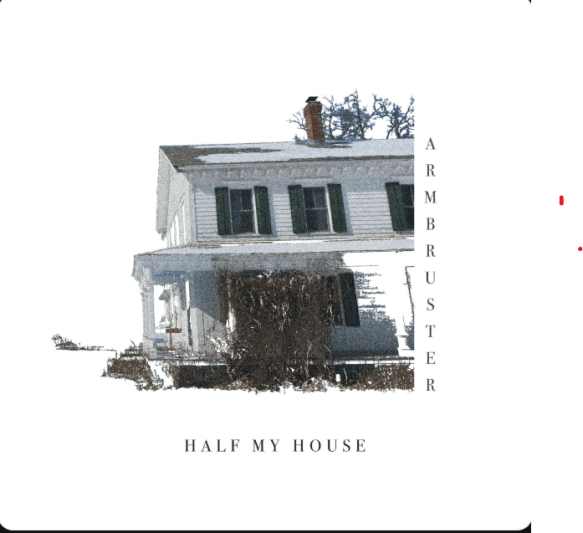
We were very pleased, therefore, upon receiving a copy of his latest offering, Half My House. Armbruster takes a similar role of the folk bard of old, taking who knows how old universally loved tunes and interpreting them in his own contemporary way. And in Armbruster’s idiosyncratic case, that contemporary way tends to make use of the post-modern (at this point we’re not actually sure how many ‘posts’ to add to this term) sounds, instrumentation, and methods of what’s often referred to as ‘post-rock’.

Which is why, given our particularly idiosyncratic tastes, we were well aware that if Armbruster’s new album was anything like his previous albums and/or live performances, it’d definitely be a banger.
In the post-rock interpretation of the term, that is. Which is of course a far more nuanced use of the term ‘banger’, for those of us that are so clearly (somewhat unfortunately) mature adults with all the emotional trauma, existential angst, and nihislist anti-philosophy that entails. Armbruster’s interpretations of folk songs evince such a contemporary spirit and the trimmings of post post post post post post modern thinking patterns and inevitable moodiness that they can’t help but feel completely relevant and relatable to us, whether we know any of the variants of the ‘original’ folk songs he’s playing on any given track.
In any case, a few notes into the record and it’s clear that if we’re looking for the kind of moody, studied, pensive variations on traditional songs we’re used to from Armbruster we will NOT be disappointed. The 4 minute long ‘King Under the River’ alone is worth the price of admission. Such a brooding, pensive inner vision of a song that frankly, no one else in the Capital District or from what we’ve heard the whole world is doing this well and authentically. It begins with a creepy rhythm that builds up just to slow down and fall apart. And like all the tunes to come, it presents itself so unpretentiously and represents such an admitted sense of tortured yet somehow presenting as harmonious inner tension I can’t help but be reminded of Schubert’s Unfinished Symphony.
And yes those contradictory phrases are entirely intentional, as this song (and Armbruster’s music in general) brilliantly juxtaposes so many conflicting emotions while still providing such an overall sense of ambiance it’s uniquely phenomenal. And just when you think it’s going to take off… BANG! It ends with a bell, leaving you hanging and unfulfilled… and wanting so much more.
While varied the album’s gothic folk undertones that run throughout all the tracks are what connects them. Which has the affect of creating an overall ambience that is both warm, inviting, joyous, yet sad and deeply, darkly thoughtful. Much of the mood evokes Van Morrison’s Astral Weeks song cycle from the sixties — is especially on the next couple of tracks; ‘Caslean Na Nor’ and ‘The Wounded Hussar’, the former giving you the ambient relief from the inner tension of the tracks it’s sandwiched in between, the latter being five and a half minutes of spare, almost formless piano, violin, and what sounds almost like a bowed sitar (at this point we should mention we don’t know what instruments he’s using or playing and we know there’s probably somewhere we could find out — but we don’t WANT to know, so transcendent is the experience invited by every track on this album).
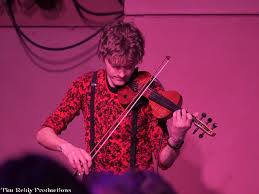
The ‘second side’ (yes we’re old enough to still talk of such archaicisms) is less a continuation of the transcendent cycle of the first part and more the kind of fresh takes on classical, traditional folk sounds that Armbruster’s famous for. Witness the effortless brilliance of the catchy fiddle melody emerging from a series of found sounds on the traditional Irish ‘Within a Mile of Dublin’ that segues immediately into a take on ‘The Ten Pound Float’ (indeed the tracks so thoroughly meld into one another they’re combined within a single track).
This is followed closely by the frenetic take on the traditionalism of The Jolly Tinker, like the kind of sped up ancient Celtic track that the early Pogues delighted in making. You can’t help but stomp your feet and clap your hands, especially as the rhythm delightedly speeds up, slows down, and changes its syncopation. The mandolin over the fiddle is the closest I’ve ever heard instrumental music come to a catchy track that keeps getting stuck in your head, in a good way.

The record ends with the silently dream like interpretation of folk tune ‘Uncle Rat’ (with singing!). The presentation of this track lacks all the common pretention of a confident folk singer yet contains all the skills. It’s presented like an Albini engineered tune; the melody buried within the vision and subsumed by ever present yet surprising windchime (perhaps a vibraphone(?)) tones. A perfect ending to make this album leave a great taste and of course leave you wanting more.
So you go back and listen to it again. And again. AND AGAIN — at least that’s what we’ve been doing.
Loving the new album, Mr. Armbruster, SIR — thanks so much for sharing it with us!

 Times Boredom